

the systems, networks, and webs that hold us together
I have been thinking about what holds us together at a time when things are falling apart.
With the newest administration in the United States, we’re experiencing the latest chapter of shock and distraction—a constant barrage of attacks on the most vulnerable. All this while we witness the internal breakdown of government systems that were never equipped to serve the people over those with wealth and power.
Pluto knows power. And since 2008, Pluto has been showing the cracks of those sources of power related to Capricorn—our governments, institutions, and the way we structure society. Now, after some dips out of Capricorn over the past couple of years, we have fully entered the cycle of Pluto in Aquarius, which will last until 2043. We’ve already seen some previews of significant themes related to Pluto in Aquarius in the collective—advancements in technology that will change the way we relate to one another (like the surge of AI powered applications), monopolies of power over the exchange of information (like Meta, Google, and Apple) and power struggles over technologies (like the US ban on TikTok), increased challenges to power through collective organizing (like the 1 million people who protested pension reforms in France), and more.

A few weeks ago, the Sun made its first conjunction with Pluto in Aquarius, illuminating the start of a decades long cycle about the power of networks—communities, groups, systems of mutual aid, technology, and the like. What I love about astrology is that at any point there are a multitude of cycles happening—from a different number of schools, perspectives, techniques, and contexts of interpretation. It’s a great reminder that our lives are made up of many interrelated and overlapping relationships, qualities, and cycles. This is also a year where multiple outer planets (Saturn, Uranus, Neptune) will be entering new signs—meaning multiple powerful shifts in energy will be happening all at once. Change and transition understandably inspire fear, grief, concern, and the potential for harm. And then also, while one aspect of life might change, there are other ties that hold us while we once again find our equilibrium.
Aquarius reminds us of these ties. As my YCIAB cohort continues to our somatic work as it relates to astrology, I’ve been thinking a lot about connective tissues, which are associated with Aquarius. As a person living chronic pain, I have a lot of sensations to notice in my body anyway, so I was having difficulty isolating and identifying exactly where I might most feel my connective tissues and how I might visualize them.
visualizing connective tissues
This month, I had the opportunity to participate in a photography workshop on campus, so I explored these questions a bit more. I haven’t taken a photography class since college—though I still remember the stench of the fixer and the strange quiet one can only experience in a crowded dark room. The instructor, Sarah Schorr, especially focuses on water, light, and plants—and to my delight, lived at Giverny where she made art using injured flowers from Monet’s garden. As part of this class, we would take a journey to Walden Pond, and explore our research question through what we encountered there. So it was an interesting opportunity to think a bit more broadly about connective tissues—through plants and other similar life.
Unfortunately, and fortunately—we’ve been experiencing freezing temperatures in Massachusetts. This makes for excellent conditions for experiencing the beauty of a frozen lake, and then also, impacts my chronic pain in significant ways—my joints and muscles further tighten and ache, my paresthesia becomes a bit more prickly, leading to more interrupted sleep, and while I don’t normally get cold, it becomes harder to regulate the temperature of my feet. Right up until the day of our trip, I struggled with the decision of whether or not to go, ultimately deciding that it was probably for the best to sit this one out.
I was grateful that the instructor understood, and she said I was welcome to explore my question at home or with previous work. I took some time to look closely at some of the trees in my neighborhood—and all the different textures and colors that appear on tree trunks in the middle of winter. It can be 10 degrees out, and still some of the tree trunks are covered in a bright yellow-green or a glowing green. This was also an opportunity to appreciate the plant life that did manage to coexist with this urban setting, during winter, when plants are at their most dormant.
Our assignment was to explore the question of “where two seas meet” and in all my creative projects, whether its nonfiction or poetry or photography, I’ve been fascinated by the body as a container. In some ways, I am still thinking about my 12th grade English teacher pointing to “FORM = MEANING” on the blackboard. So when thinking about various entities as a “body”—our literal bodies, the home we live in, our neighborhood, the lands on which we reside, the planet Earth—there are countless systems and “organs” playing a role within those bodies.
Connective tissues exist in every part of our body, I quickly learned—they hold us together, playing roles of binding and supporting, protecting, insulating, storing reserves of fluid and energy, and transporting substances within the body.1 And they come in unique forms based on the function that they play. Our skin, ligaments, bones, blood, and fat are all different types of connective tissues that give us shape and structure. To try to visualize these webs of connection further in other contexts of “the body”, I paired pictures of connective tissue from the Berkshire Community College Bioscience Image Library with images of plant life in my surrounding area.
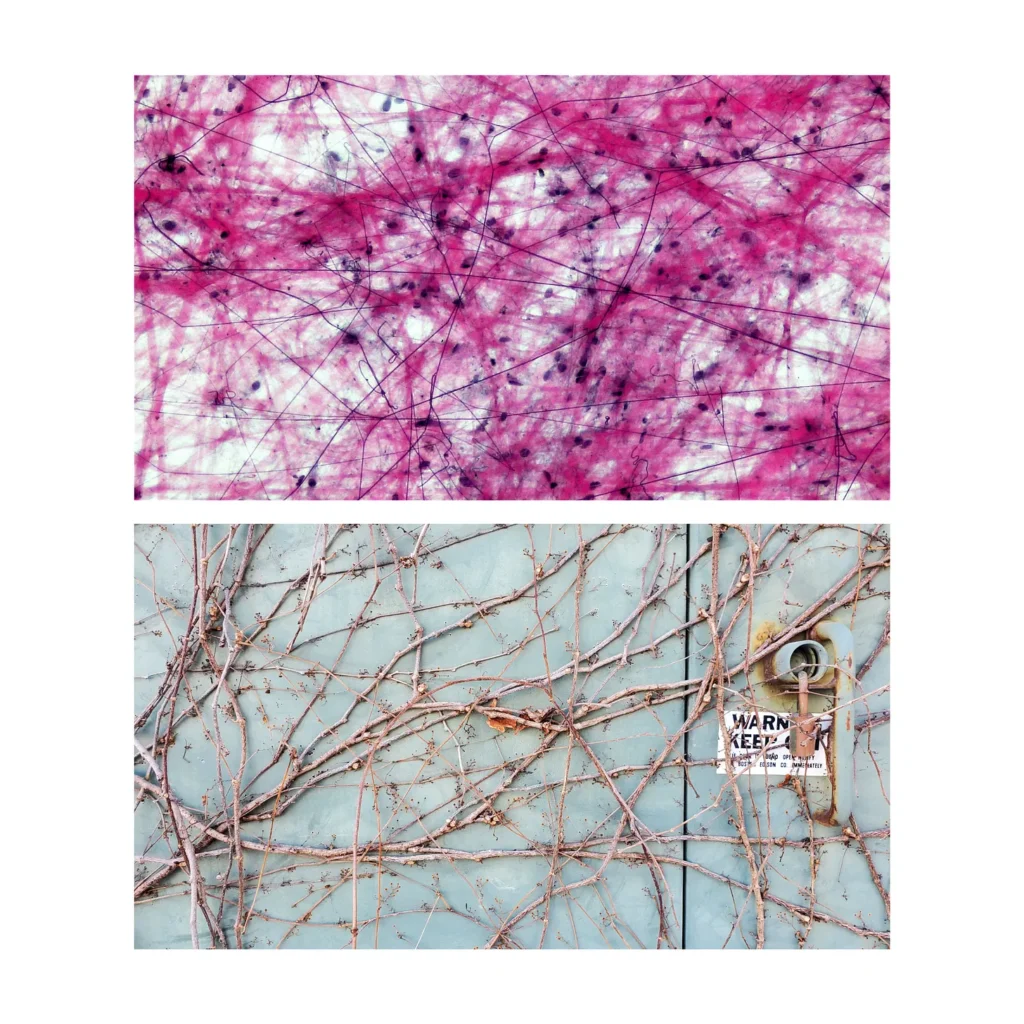
Bottom: Boston Ivy surrounds transformer, suzannah lutz
networks as resource reservoirs
Areolar tissues like the ones above are named for the “little open spaces” between fibers that hold fluids and other nutrients. These tissues hold organs in place, serve as a reservoir of water and salts for surrounding tissues. Almost all cells obtain their nutrients from and release their wastes into areolar connective tissue.2
While the ivy vines in the picture above are bare at the moment, in the spring and summer, they are lush with green leaves that provide shelter for a flock of sparrows that circle the area for fallen blossoms from a nearby tree. Humans use Boston Ivy to decorate buildings and cover up unsightly landscaping (and maybe even transformers!)—and apparently they function as a good sound barrier, which makes me appreciate this particular Ivy even more.
Aquarius shows us the power of pooling resources through networks of mutual aid, food distribution, community fridges and freezers, free vaccine clinics, teach-ins, freecycles, clothing swaps, little free libraries, neighborhood pods, free COVID-mask and test distribution, and more.
networks as protective cushions
Connective tissues also act as a supportive cushion, protecting our bones and joints from too much friction by acting as a supportive cushion. The reticular tissue above can be found around bone marrow, forming a framework for blood vessels that allow for the transportation of vital oxygen and nutrients to the rest of the body.
Also above, lichen nests on the bark of a tree. In winter, lichen help trees survive frigid temperatures by producing antifreeze proteins.3 Lichen themselves function as a mutualistic relationship between a colony of algae living amongst fungi and other yeasts and bacteria—contributing to many natural cycles like the harvesting of nutrients from fog, dew, and other airborne particles.
In this respect, Aquarius knows that there is great power and protection in collective action: through the organizing and negotiation of labor unions, grassroots movements, protest, solidarity, group projects, chore wheels, and all the ways we can work together for a shared vision. I will take this opportunity to note that the Fellowship of the Ring was a very Aquarian solution (distributing one burdensome task to improve life for mankind among a skilled group of leaders), foiled by some very Leo hubris (when one person’s pride overtook his hold on reality).4
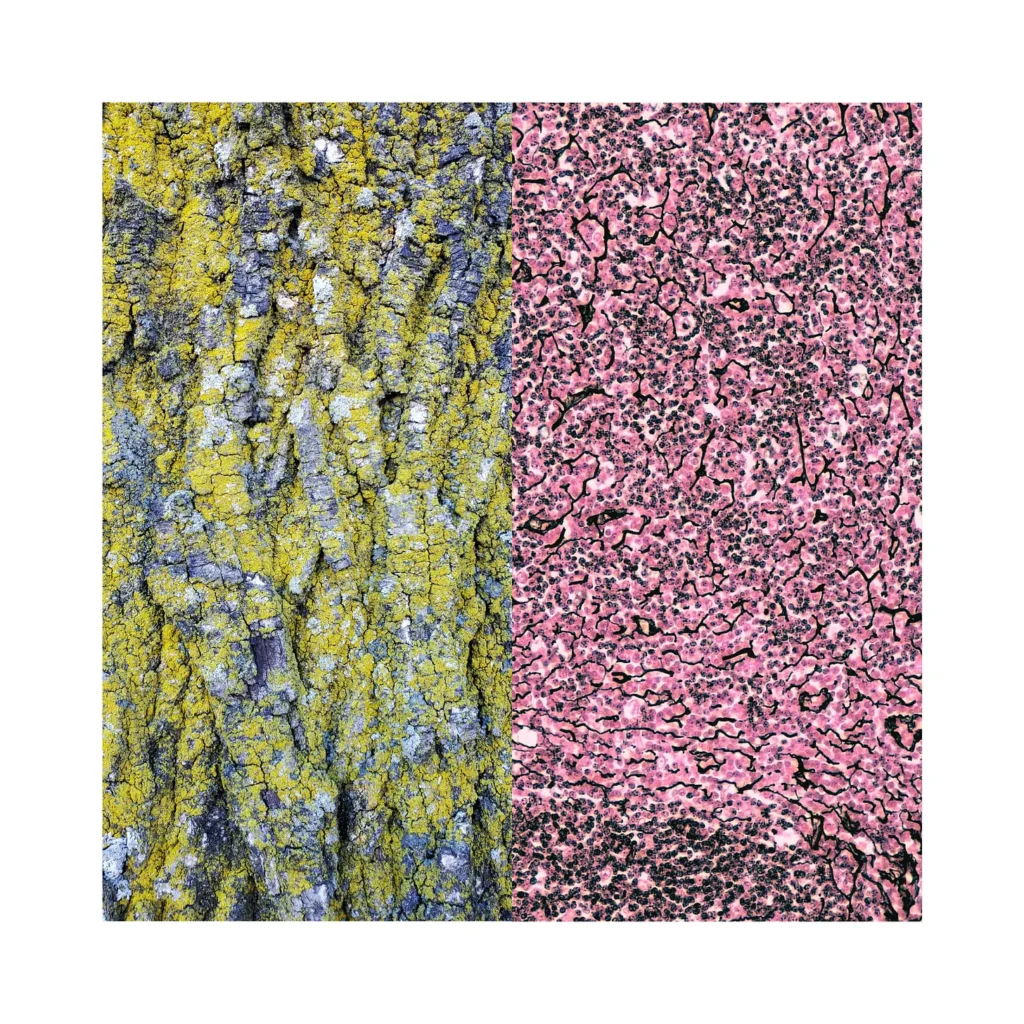
Right: Connective Tissue: Reticular: cross section: magnification 200x, Berkshire Community College Bioscience Image Library
networks as anchors
Connective tissues also function as anchors for vital organs in our bodies. Without the fibers and tissues surrounding the kidneys, for example, they would have nothing to hold them in place, making them more susceptible to dysfunction.
Anchors also embody the fixed energy of Aquarius—it holds on—and as an air sign, it holds on to the networks and frameworks of knowledge that are working most logically and beneficially for society. Hermione Granger is solidly a Virgo, no questions asked, but her impulse “When in doubt, go to the library” is also very Aquarian—to anchor oneself in the knowledge that has stood the test of time.
The last photo I’m sharing is a picture of my altar, which was taken as a self portrait for this assignment. As I continued to think about connective tissues, especially in the context of Aquarian themes, I also thought about how each of us are anchors of the various communities, ideologies, networks, and time periods of humanity within which we find ourselves existing. My altar is a collection acknowledging these different webs, and what anchors them all is my participation. Feeling into that complementary energy between the self (Leo) and the collective (Aquarius) is just one of many of the themes we’ll encounter in the years ahead, and leaning into the power of those webs of connection is especially important. Below, I offer some questions for reflection as support.
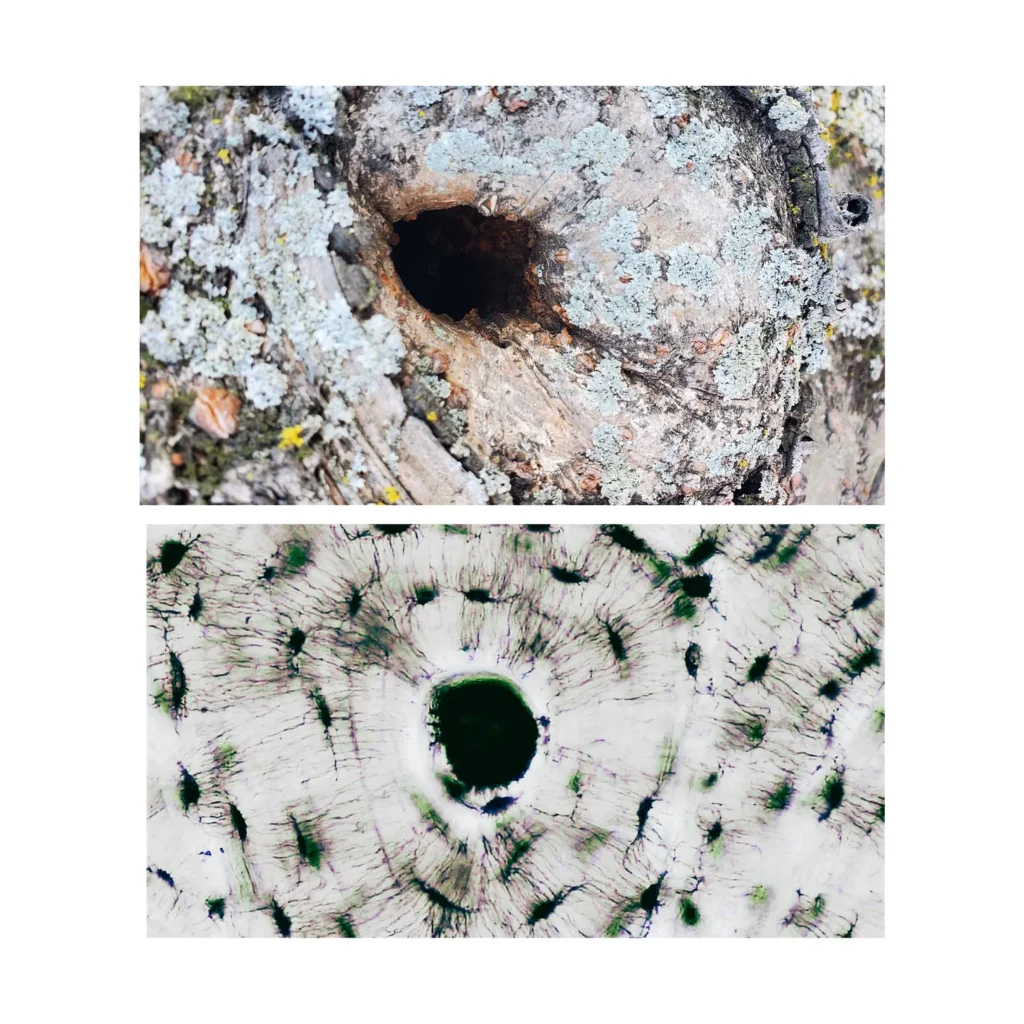
Right: Connective Tissue: Reticular: cross section: magnification 200x, Berkshire Community College Bioscience Image Library
prompts for self-reflection
- Who or what holds you together? (literally, figuratively, socially, physically, ideologically, emotionally, creatively, mentally, spiritually, and all the different ways you are propped up by systems of support)
- If you’re not feeling particularly held together right now (that’s okay!), close your eyes and notice your breath for as long as you like. When you feel ready, put your hand over your heart. Where could you use some support right now? What does that support look like? If it’s hard to imagine something practical, imagine the most ideal situation. That might also give you some helpful information to start.
- What reservoirs of resources do you have access to? Are there additional networks you could participate in, whether giving or receiving? Are there ways to share resources (information, supplies, skills) you have access to with broader groups of people?
- What might be easier if you could share the load with others? (e.g. body doubling, parallel play, or borrowing a tool from a friend, rather than purchasing it because you’re only going to use it once.)
- What’s a quote that anchors you when you’re feeling in doubt?
- Create an altar that honors your many webs of connections.
Thanks, as always, for reading, and please take good care.
- Tissues, Part 3 – Connective Tissues: Crash Course Anatomy & Physiology (YouTube) ↩︎
- Anatomy & Physiology, 2019 by Lindsay M. Biga, Staci Bronson, Sierra Dawson, Amy Harwell, Robin Hopkins, Joel Kaufmann, Mike LeMaster, Philip Matern, Katie Morrison-Graham, Kristen Oja, Devon Quick, Jon Runyeon, OSU OERU, and OpenStax (OSU) ↩︎
- Lichens: Winter Survivalists (Northern Woodlands) ↩︎
- Sorry Boromir. ↩︎
Leave a Reply